Research Interests and Streams
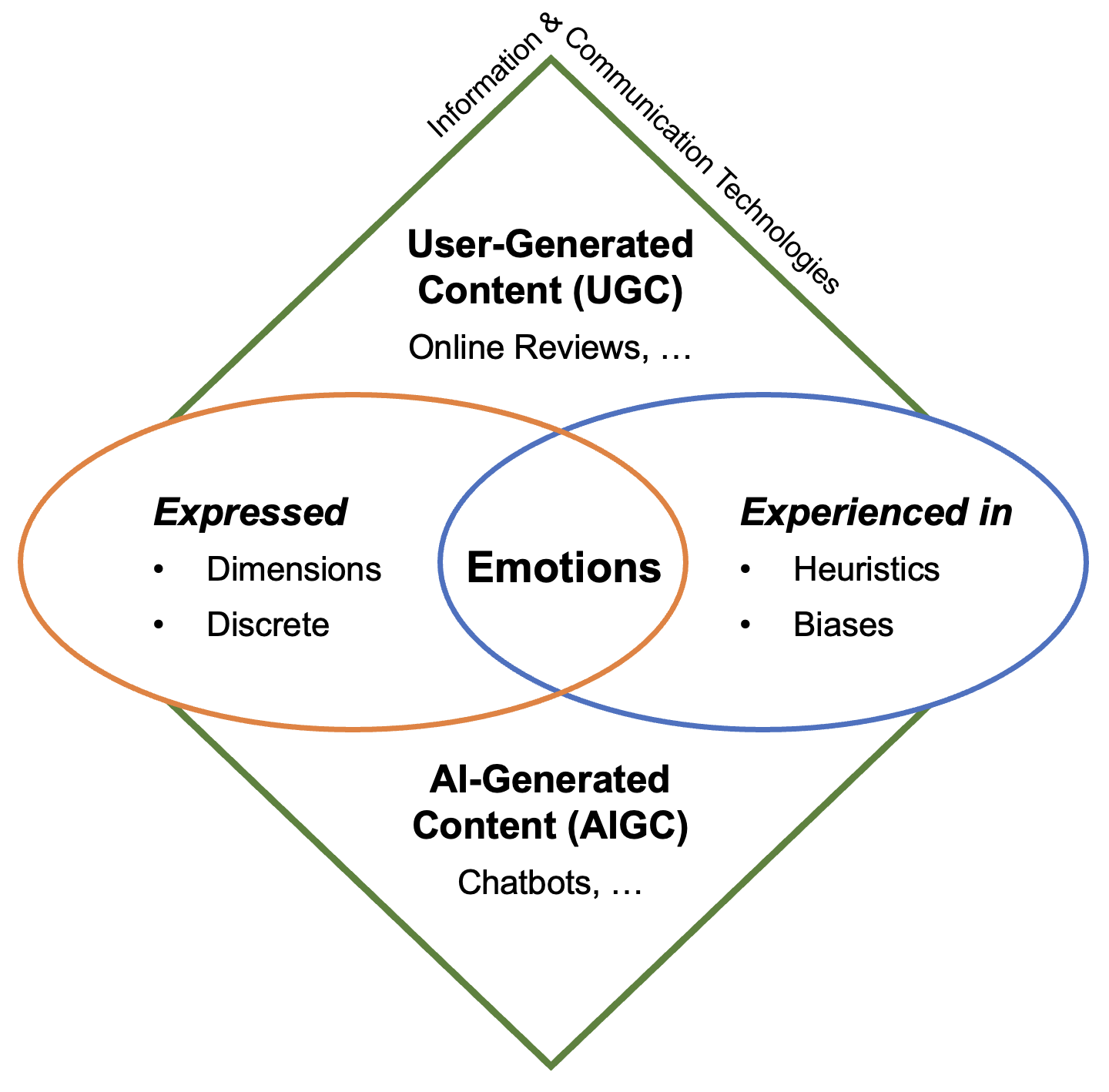
- Expressed emotions in online environments: 1, 3, 4, 5, 7, 9, 12, 15, 17
- Observer judgment and use of UGC: 1, 2, 3, 5, 6, 7, 8, 10, 11, 13, 14, 15, 18
Journal Articles
- Yu, Y., Yin, D., Khern-am-nuai, W., Pinsonneault, A., & Wei, Z. (forthcoming). Helpful or Unhelpful: The Hidden Influence of Review Voters and the Wisdom of Crowds. Journal of the Association for Information Systems. [AbstractAbstract]
Online review platforms use voting systems to identify and promote helpful reviews, aiming to alleviate information overload for potential consumers. Existing research has primarily focused on how review and reviewer characteristics affect review helpfulness, but it has largely overlooked the role of voters. Drawing on cognitive consistency theories, we propose that review voters cast votes in ways that align with their historical content-related activities, perceptions of review context, and social relationships with reviewers. Using a unique, fine-grained vote-level dataset, we find that voter-related factors have a more pronounced impact on review helpfulness than review or reviewer characteristics do. These findings suggest that past research examining antecedents of review helpfulness may have overestimated the effects of review and reviewer characteristics and that more attention to voters is warranted.
- Han, E., Yin, D., & Zhang, H. (forthcoming). Bots with Empathy: Reactance Against Emotion-Aware AI Agents in Customer Service. MIS Quarterly. [AbstractAbstract]
The advance of artificial intelligence (AI) technologies has enabled chatbots to be emotionally responsive. In customer service, expressing empathy is a critical component of employee emotional responsiveness and a popular recovery strategy following service failure. However, the impact of empathy expressed by a chatbot is less clear. In this research, we investigate how and why chatbot-expressed empathy after service failure may influence customers’ service evaluations differently. Extending the psychological reactance literature, we propose that an empathetic chatbot may trigger customer reactance due to the unique nature of AI chatbots (vs. humans). We further propose that the triggered reactance can undermine perceptions of a chatbot’s competence and warmth, ultimately hurting service evaluations. We conducted three laboratory experiments to test these predictions. Our theoretical framework and findings illuminate the more nuanced and distinct role of empathy expressed by AI chatbots, and they suggest a critical need for chatbot developers and companies deploying chatbots to be aware of user reactance in customer service.
- Yin, D., Mullarkey, M., de Vreede, G. J., & Limayem, M. (forthcoming). Learning by Phishing via Post-Simulation Feedback: From Embedded to Non-Embedded Training. MIS Quarterly. [AbstractAbstract] [Link to Article]
Given the frequent occurrence of phishing attacks and their devastating consequences, organizations increasingly deploy phishing simulation emails to quantify employee susceptibility (e.g., clicking within-email links) and invest in training programs to reduce such susceptibility. Interestingly, phishing simulations can also be turned into a training opportunity in themselves. A best practice in industry is “embedded training”—providing immediate feedback on landing pages to employees who fail the simulations. This intervention is intuitively appealing given its “just-in-time” nature. Although laboratory studies from the literature offered broad support for its effectiveness in reducing employee susceptibility, studies conducted in field settings observed weaker evidence or even a reversed, enhancing impact. In this research, we recognize an inherent shortcoming of the real-world implementation of embedded training: limited reach. To address this practical challenge, we propose an alternative, novel intervention—”non-embedded training”—that decouples feedback from the failure action and sends delayed feedback to all the employees. Following an “empirics-first” approach, we conducted three randomized field experiments using a leading phishing simulation platform to explore the respective and combined effects of embedded and non-embedded training in reducing user vulnerability over time. This research contributes to the practice and literature on phishing and cybersecurity by challenging the assumed effectiveness of embedded training in practice and revealing how non-embedded training could be a more promising intervention.
- Yin, D., Bond, S. D., & Zhang, H. (forthcoming). Tripartite Reactions to Emotions (TRE) Theory: The Impact of Emotional Expressions in User-Generated Content. MIS Quarterly. [AbstractAbstract] [Link to PDF]
Although emotional expression is commonplace in online User-Generated Content (UGC), theoretical understanding of its consequences is limited and fragmented. We advance a theory of Tripartite Reactions to Emotions (TRE) in UGC that addresses the following question: When and how do content creators’ emotional expressions about a target influence observers’ behaviors toward the target and the content itself? Integrating and extending existing theories, TRE theory distinguishes between two kinds of observer behavior, proposes three distinct cognitive and affective pathways, and highlights the moderating influence of UGC context. To guide future research, we develop an extended, dynamic model that allows for interactions among pathways, and we illustrate the application of TRE in an online word-of-mouth setting. TRE represents a novel, emotion-focused theory that researchers in information systems and other disciplines can leverage to explore the interpersonal impacts of emotional expressions on UGC platforms.
- Yin, D., Bond, S. D., & Zhang, H. (forthcoming). The Illusion of Authenticity in Online Reviews: Truth Bias and the Role of Valence. Information Systems Research. [AbstractAbstract] [PDF]
Despite a growing stream of research documenting the prevalence of “fake” online reviews and improving their automated detection, little is known about how consumers make real or fake judgments of reviews with unknown veracity. Integrating literature on truth-default theory and deception motives, we propose that consumers have a general tendency to view reviews as real rather than fake (a truth bias) and to be more accurate at detecting real reviews than fake reviews (a veracity effect). Moreover, we argue that the truth bias is weaker for positive reviews than negative reviews (a valence effect) because of a largely automatic process in which consumers project deception motives onto reviewers. To test these proposals, we conducted five experiments in which participants classified sets of reviews as real or fake. Results provided broad support for our theorizing, and they have important implications for firms and platforms as they establish priorities for combating fake reviews.
- Lei, Z., Yin, D., & Zhang, H. (2025). Deliberative or Automatic: Disentangling the Dual Processes Behind the Persuasive Power of Online Word-of-Mouth. MIS Quarterly, 49(1), 331-346. [AbstractAbstract] [PDF]
As online reviews become increasingly indispensable for consumers, they have attracted significant attention from both practitioners and researchers. It is a common belief that the persuasive effect of online reviews involves a deliberative and conscious process. Drawing on dual-process theories and the persuasion literature, we challenge this conventional wisdom, distinguish Type 2 processing (which requires deliberation) and Type 1 processing (which occurs automatically), and disentangle their relative impacts. With a focus on review elaborateness and review exposure, we propose that the automatic process of review exposure may play a greater role than elaborateness in changing consumers’ attitudes and purchase intentions. In addition, in line with the negativity bias, we posit that the persuasive impact of review exposure (vs. elaborateness) is moderated by the valence of highly exposed reviews. The results of the two experiments provide consistent support for these predictions. Our findings complement and extend the emerging literature starting to explore the role of automatic Type 1 processing in consumers’ use of online reviews, reveal the primary driver of persuasion and its boundary condition in online word-of-mouth, and provide important implications for review platforms, product manufacturers, and retailers.
- Han, E., Yin, D., & Zhang, H. (2023). Bots with Feelings: Should AI Agents Express Positive Emotion in Customer Service? Information Systems Research, 34(3), 1296-1311. [AbstractAbstract] [PDF]
Customer service employees are generally advised to express positive emotion in their interactions with customers. The rise and maturity of artificial intelligence (AI) powered conversational agents, also known as chatbots, beg the question: should AI agents be equipped with the ability to express positive emotion in customer service? This research explores how, when, and why an AI agent’s expression of positive emotion affects customers’ service evaluations. We argue that AI-expressed positive emotion can influence customers via dual pathways: an affective pathway of emotional contagion and a cognitive pathway of expectation-disconfirmation. We propose that positive emotion expressed by an AI agent (vs. a human employee) is less effective in facilitating service evaluations because of a heightened level of expectation-disconfirmation. We further introduce customers’ relationship norm orientation as a novel individual difference variable that affects their expectations toward the AI agent and moderates the cognitive pathway of expectation-disconfirmation. Results from three laboratory experiments substantiate our claims. By revealing a distinctive impact of positive emotion expressed by an AI agent compared with a human employee, these findings deepen our understanding of customers’ reactions to emotional AIs and offer valuable insights for the deployment of AIs in customer service.
- Yin, D., de Vreede, T., Steele, L. M., & de Vreede, G. J. (2023). Decide Now or Later: Making Sense of Incoherence Across Online Reviews. Information Systems Research, 34(3), 1211-1227. [AbstractAbstract] [PDF]
Mixed or inconsistent opinions are commonplace in online reviews. Prior research shows that review inconsistency has different effects: its product-level manifestation in the form of inconsistent product ratings is associated with poorer sales, but its review-level manifestation in the form of two-sided arguments is associated with greater helpfulness and credibility evaluations of the review. In practice, consumers rarely consult all reviews or just a single review before they make purchase decisions. Instead, they often read a set of featured reviews (i.e., a review set) and some additional reviews if needed. Focusing on inconsistency in a review set, we introduce a new type of inconsistency across reviews that does not exist within a single review or at the level of product ratings: cross-review incoherence, which refers to disagreement among reviewers about specific product features. Based on cognitive dissonance theory, we explore how and when cross-review incoherence influences helpfulness and credibility judgments of the review set, revealing that consumers’ reactions to such incoherence might operate differently beyond an individual review. In addition, we examine how and why consumers’ judgments of a review set influence their purchase deferral—that is, the likelihood of making a buy-or-not-buy decision immediately after consulting the top reviews or deferring it until after obtaining more information. Two laboratory experiments demonstrate that cross-review incoherence increases purchase deferral via more negative evaluations of the review set that, in turn, reduce attitude certainty. In addition, the negative effect of cross-review incoherence on review set evaluations is weaker when the reviewers provide more contextual information behind their opinions. These findings deepen our understanding of inconsistency across multiple pieces of information; reveal the consequences of review evaluations during an understudied stage of consumers’ decision-making process; and provide critical implications for review platforms, companies, and reviewers.
- Lei, Z., Yin, D., & Zhang, H. (2023). Positive or Negative Reviews? Consumers’ Selective Exposure in Seeking and Evaluating Online Reviews. Journal of the Association for Information Systems, 24(4), 1162-1183. [AbstractAbstract] [PDF]
How and why positive and negative reviews influence product sales differently has critical implications for both research and businesses. Although earlier online word-of-mouth research empirically documented that negative reviews influence product sales to a greater extent than positive reviews (i.e., a negativity bias), later research has revealed that positive reviews are generally more helpful (i.e., a positivity bias). We propose that an answer to this conundrum may be that negative reviews get more exposure than positive reviews. As consumers are often overwhelmed by the massive number of online reviews, they need to be selective when searching for reviews. This research investigates consumers’ preference for positive vs. negative reviews during both the information-seeking and information-evaluation stages of their decision-making process. Drawing on the motivated reasoning literature, we propose that consumers exhibit a negativity bias when they search for reviews to read but manifest a confirmation bias when they evaluate the helpfulness of reviews. We conducted three experiments and found consistent support for these hypotheses. Our findings expand the current understanding of consumers’ processing of online reviews to the information-seeking stage, reveal differential biases at different stages, demonstrate a possible explanation for the negativity bias in product sales, and provide important practical implications.
- Jiang, L., Yin, D., Liu, D., & Johnson, R. (2023). The More Enthusiastic, The Better? Unveiling a Negative Pathway from Entrepreneurs’ Displayed Enthusiasm to Funders’ Funding Intentions. Entrepreneurship Theory and Practice, 47(4), 1356–1388. [AbstractAbstract] [PDF]
Displaying enthusiasm (an emotional manifestation of passion) is a common practice for entrepreneurs to attract crowdfunding. However, we propose that funders may attribute an entrepreneur’s displayed enthusiasm to impression management motives, which can in turn reduce their funding intentions. Moreover, this negative pathway is more likely to occur when the entrepreneur is perceived to have lower domain expertise. We found consistent support for these hypotheses from a survey and an experiment. Our findings suggest that displaying enthusiasm may not always be effective for entrepreneurs because there are both positive and negative pathways underlying the influence of displayed enthusiasm on funders.
- Lei, Z., Yin, D., Mitra, S., & Zhang, H. (2022). Swayed by the Reviews: Disentangling the Effects of Average Ratings and Individual Reviews in Online Word-of-Mouth. Production and Operations Management, 31(6), 2393-2411. (Lead Article). [AbstractAbstract] [PDF]
Online word-of-mouth studies generally assume that a product’s average rating is the primary force shaping consumers’ purchase decisions and driving sales. Similarly, practitioners place more emphasis on average ratings by displaying them at more salient places than individual reviews. In contrast, emerging evidence suggests that individual reviews also affect the decision-making of those consumers who consult both kinds of information. However, because average ratings and individual reviews are often correlated and confounded empirically, little research has attempted to disentangle their effects. To address this empirical challenge, we construct trade-off situations in which the average ratings and top-ranked reviews of different product options do not align with each other. We then investigate consumers’ preferences that can indirectly reveal the relative impact of average ratings vs. top reviews. Through an archival analysis of a panel dataset and two laboratory experiments, we find consistent evidence for a swaying effect of individual reviews and reveal their textual content as a likely reason. These findings challenge the commonly accepted assumption of average ratings being the primary driver of consumers’ purchase decisions and suggest that consumers may not be as rational as previous literature assumed. In addition, this paper is the first to disentangle the effects of average ratings and individual reviews on consumer decision-making and to explore a possible reason for the swaying effect of individual reviews. Our paper illustrates the importance of information accessibility in consumers’ purchase decisions, and our findings offer valuable insights for product manufacturers, online retailers, and review platforms.
- Yin, D., Bond, S. D., & Zhang, H. (2021). Anger in Consumer Reviews: Unhelpful but Persuasive? MIS Quarterly, 45(3), 1059-1086. [AbstractAbstract] [PDF]
A common assumption in prior research and practice is that more helpful online reviews will exert a greater impact on consumer attitudes and purchase decisions. We suggest that this assumption may not hold for reviews expressing anger. Building on Emotions as Social Information (EASI) theory, we propose that although expressions of anger in a negative review tend to decrease reader perceptions of review helpfulness, the same expressions tend to increase the negative influence of the review on reader attitudes and decisions. Results from a series of laboratory experiments provide support for our claims. Our findings challenge the widely accepted assumption that more “helpful” reviews are ultimately more persuasive, and they extend current understanding of the interpersonal effects of emotion in online communication. Our findings also suggest implications for review platforms, retailers, marketers, and manufacturers faced with the task of managing consumer reviews.
- Lei, Z., Yin, D., & Zhang, H. (2021). Focus Within or On Others: The Impact of Reviewers’ Attentional Focus on Review Helpfulness. Information Systems Research, 32(3), 801-819. [AbstractAbstract] [PDF]
When reviewers write online reviews, they differ in the focus of their attention: some focus on their own experiences, whereas some direct their attention to others—prospective consumers who may read the reviews in the future. This paper explores how, why, and when reviewers’ attentional focus can influence the helpfulness evaluation of reviews beyond the impact of substantive review content. Drawing on the attentional focus and persuasion literatures, we develop a theoretical model proposing that reviewers’ attentional focus may influence consumers’ perception of review helpfulness through opposing processes, and that its overall effect is contingent on the review’s two-sidedness. Results of one archival analysis and five controlled experiments provide consistent support for our hypotheses. This work challenges the predominant view of the positive impact of other-focus (vs. self-focus), explores the interpersonal impact of a reviewer’s attentional focus on prospective consumers who are total strangers, and reveals an important, context-specific boundary condition.
- Peng, C. H., Yin, D., & Zhang, H. (2020). More than Words in Medical Question-and-Answer Sites: A Content-Context Congruence Perspective. Information Systems Research, 31(3), 913-928. [AbstractAbstract] [PDF]
Given the popularity and prevalence of medical question-and-answer (Q&A) services, it is increasingly important to understand what constitutes a helpful answer in the medical domain. Prior studies on user-generated content have examined the independent impacts of content and source characteristics on reader perception of the content’s value. In the setting of medical Q&A sites, we propose a novel content-context congruence perspective with a focus on the role of congruence between an answer’s content and the answer’s contextual cues. Specifically, we identify two types of contextual cues critical in this unique setting—the language attributes (i.e., concreteness and emotional intensity) of the question’s content, and the acuteness of the disease to which the question is related. Building on the priming literature and construal-level theory, we hypothesize that an answer will be perceived as more helpful if the language attributes of the answer’s content are congruent with those of the preceding question, and if they are congruent with the disease’s acuteness. Analyses of a unique data set from WebMD Answers provide empirical evidence for our theoretical model. This research deepens our understanding of readers’ value judgment of online medical information, demonstrates the importance of considering the congruence of content with contextual cues, and opens up exciting opportunities for future research to explore the role of content-context congruence in all varieties of user-generated content. Our findings also provide direct practical implications for knowledge contributors and Q&A sites.
- Jiang, L., Yin, D., & Liu, D. (2019). Can Joy Buy You Money? The Impact of the Strength, Duration, and Phases of an Entrepreneur’s Peak Displayed Joy on Funding Performance. Academy of Management Journal, 62(6), 1848-1871. [AbstractAbstract] [PDF]
Does displaying positive emotions (e.g., joy) during a funding pitch help an entrepreneur gain more financial support? Past research has approached this question mostly by treating emotional displays as static and focusing on the overall or average levels of displayed emotions. However, emotional displays are temporally dynamic and more salient in some moments or phases than others. Drawing from gestalt characteristics and event system theories, we take a dynamic approach to examine the “peak” moments of entrepreneurs’ displayed joy—specifically, the strength and duration of peak displayed joy during different phases of a pitch. We analyzed data from over eight million frames in 1,460 pitch videos, using the latest facial expression analysis technology. The findings unveil the benefit of pitching with a greater level of peak displayed joy, especially during the beginning and ending phases of a pitch. Moreover, the amount of time an entrepreneur spends at the peak level of his or her displayed joy has an inverted U-shaped relationship with funding performance. This research highlights not only the importance of investigating emotion temporal dynamics in the interpersonal context, but also the unique research opportunities provided by facial expression analyses in understanding complex management phenomena.
- Yin, D., Bond, S. D., & Zhang, H. (2017). Keep Your Cool or Let it Out: Nonlinear Effects of Expressed Arousal on Perceptions of Consumer Reviews. Journal of Marketing Research, 54(3), 447-463. [AbstractAbstract] [PDF]
This research explores how expressed emotional arousal in a consumer review affects reader perceptions of its helpfulness. Drawing from research on written communication and lay theories of emotion, the authors propose a pattern of diminishing returns, in which the marginal effect of arousal on perceived helpfulness is positive at low levels of arousal but diminishes at higher levels. Results of a field study using Apple’s App Store, a follow-up survey, and two laboratory experiments provide consistent evidence for the predicted pattern. In addition, the results suggest that the nonlinear effect is explained in part by perceptions of reviewer effort and that the effect is stronger for products that are utilitarian in nature. By revealing a nuanced relationship between emotional expression and perceived helpfulness, these findings offer valuable implications for effective word-of-mouth communication.
- Yin, D., Mitra, S., & Zhang, H. (2016). When Do Consumers Value Positive vs. Negative Reviews? An Empirical Investigation of Confirmation Bias in Online Word of Mouth. Information Systems Research, 27(1), 131-144. [AbstractAbstract] [PDF]
In the online word-of-mouth literature, research has consistently shown that negative reviews have a greater impact on product sales than positive reviews. Although this negativity effect is well documented at the product level, there is less consensus on whether negative or positive reviews are perceived to be more helpful by consumers. A limited number of studies document a higher perceived helpfulness for negative reviews under certain conditions, but accumulating empirical evidence suggests the opposite. To reconcile these contradictory findings, we propose that consumers can form initial beliefs about a product on the basis of the product’s summary rating statistics (such as the average and dispersion of the product’s ratings) and that these initial beliefs play a vital role in their subsequent evaluation of individual reviews. Using a unique panel data set collected from Apple’s App Store, we empirically demonstrate confirmation bias—that consumers have a tendency to perceive reviews that confirm (versus disconfirm) their initial beliefs as more helpful, and that this tendency is moderated by their confidence in their initial beliefs. Furthermore, we show that confirmation bias can lead to greater perceived helpfulness for positive reviews (positivity effect) when the average product rating is high, and for negative reviews (negativity effect) when the average product rating is low. Thus, the mixed findings in the literature can be a consequence of confirmation bias. This paper is among the first to incorporate the important role of consumers’ initial beliefs and confidence in such beliefs (a fundamental dimension of metacognition) into their evaluation of online reviews, and our findings have significant implications for researchers, retailers, and review websites.
- Yin, D., Bond, S. D., & Zhang, H. (2014). Anxious or Angry? Effects of Discrete Emotions on the Perceived Helpfulness of Online Reviews. MIS Quarterly, 38(2), 539-560. [AbstractAbstract] [PDF]
This paper explores the effects of emotions embedded in a seller review on its perceived helpfulness to readers. Drawing on frameworks in literature on emotion and cognitive processing, we propose that over and above a well-known negativity bias, the impact of discrete emotions in a review will vary, and that one source of this variance is reader perceptions of reviewers’ cognitive effort. We focus on the roles of two distinct, negative emotions common to seller reviews: anxiety and anger. In the first two studies, experimental methods were utilized to identify and explain the differential impact of anxiety and anger in terms of perceived reviewer effort. In the third study, seller reviews from Yahoo! Shopping web sites were collected to examine the relationship between emotional review content and helpfulness ratings. Our findings demonstrate the importance of examining discrete emotions in online word-of-mouth, and they carry important practical implications for consumers and online retailers.
Journal Editorials and Book Chapters/Monographs
- Maruping, L., Yin, D., Chen, A., Kankanhalli, A., Burton-Jones, A., & Brown, S. (2025). Editor’s Comments: Quantitative Behavioral IS Research – A Look Back and a Look Forward. MIS Quarterly, 49(1), iii-xviii. [PDF]
- Jabr, W., Liu, B., Yin, D., & Zhang, H. (2020). Online Word-of-Mouth. In A. Bush & A. Rai (Eds.), MIS Quarterly Research Curations. [Link]
 Dezhi (Denny) Yin